Framework for Synchronous ESL/EFL Business Vocabulary Acquisition
1. The Neuroscience of Why This Works
Traditional «read and repeat» methods fail because they overload working memory. Our framework is built on Mayer’s Cognitive Theory of Multimedia Learning, utilizing three core principles:
- Dual Coding Theory: By pairing native human audio with high-context imagery, we create two separate memory traces in the brain instead of one.
- Cognitive Load Optimization: We segment complex financial terms into interactive «bursts,» preventing learner burnout.
- Active Retrieval Effect: Every session requires the learner to produce sounds or type letters, moving the vocabulary from passive recognition to active production.
2. The: Strategic Drills
📇 I. Warm-up Flipcards (Series Type A)
The Setup: 30-word sets featuring meaningful imagery (e.g., «Accrual,» «Equity») paired with high-quality human audio and IPA transcriptions.
- The Dynamics: Learners take turns listening, repeating (modeling), and verifying True/False definitions.
- The Goal: Establishing an initial phonetic baseline and eliminating L1 (native language) interference.
🎧 II. Select Media (Audio Discrimination)
The Setup: An audio-only challenge where learners hear a definition and must select the correct term from three audio-based options.
- The Dynamics: This removes the «text crutch,» forcing the brain to process pure business English sounds.
- The Goal: Strengthening auditory discrimination and preparing the learner for real-world accents.
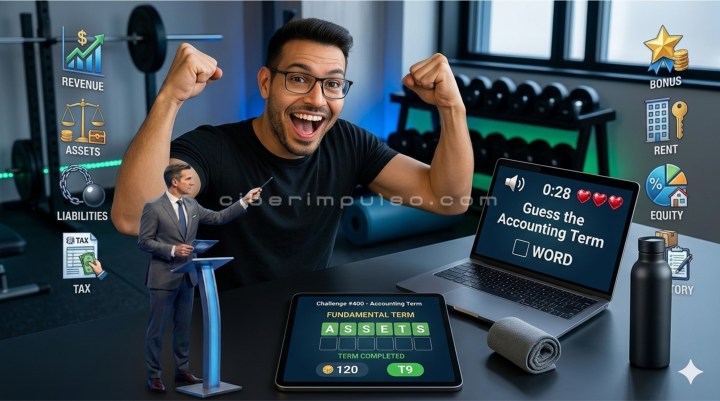
⌨️ III. Wordguess (Kinesthetic Spelling)
The Setup: Learners listen to a term or a sample accounting sentence and must type the missing letters into a synchronous interface.
- The Dynamics: A race against the clock that connects auditory input to physical motor skills (typing).
- The Goal: Cementing the spelling of terms that contain difficult English phonemes.
🔄 IV. Quick English Text
The Setup: Rapid-fire translation matching. Learners hear the English term and must select the Spanish equivalent instantly.
- The Dynamics: A high-speed drill used to measure the «fluency» of semantic retrieval.
- The Goal: Reducing the «mental lag» during business conversations.
🧩 V. WordGuessing
The Setup: Deductive guessing. The group is given four progressive hints to identify a single complex term.
- The Dynamics: Collaborative problem solving that requires learners to synthesize everything they have learned.
- The Goal: Creating the strongest possible synaptic bonds through the «Aha!» moment of discovery.
3. Aggregate Learning Outcomes
When these five tools are used in a single Zoom session, the result is an integated improvement across all language dimensions:
- Retention Speed: 95% faster than traditional study.
- Pronunciation Accuracy: Improved through repeated modeling of human audio.
- Auditory Discrimination: High ability to distinguish similar-sounding financial terms.
- Semantic Depth: Understanding not just the word, but its context and definition.
Methodology Conclusion: This is not just «playing games»—it is a structured, University of Cambridge Qualified ESL/EFL Teacher-facilitated pedagogical sequence that guarantees high-level business English fluency in a fraction of the time.

